Beginning October 1st, we will be offering a subscription for 50% off for an entire year of Stock Talk, $40 instead of the current $80. That is $3.33 a month, if paid in full at time of a new subscription, or renewal. This is an open-ended offer, it might last a week, might last a month, or through the rest of 2025. On October 1st we will start including a paywall in some of our articles. Thanks
Stock Talk
Launched 9 Months Ago
Hi, I’m Papa Phil, the founder of a space called Stock Talk. I combine my decades working in Finance, Entrepreneurship & Technology with my passion and curiosity for finding great companies, to make it easier for people to invest or trade.
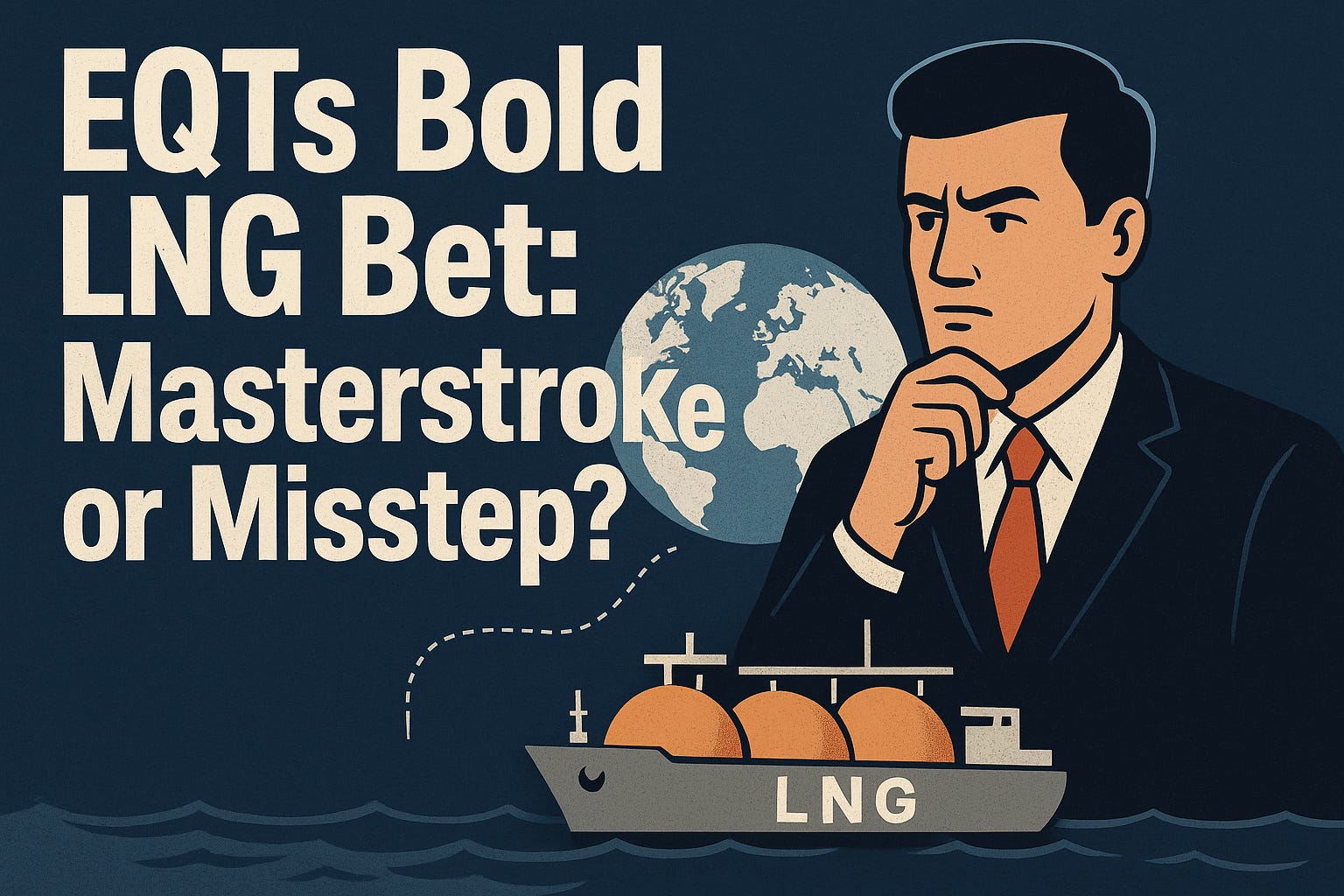
Can EQT make real money wholesaling (LNG) Liquified Natural Gas, and in turn make you money? Natural gas is cheap in the U.S. as it is $3 per million BTUs (British Thermal Units). That same fuel metric sells for more than $11 in Europe and Asia. The $8 spread is wide enough to make a trader’s heart race, and Pittsburgh-based EQT thinks it can close the gap and keep the difference.
Instead of just digging gas out of the Appalachian Basin of the United States and selling it at home, EQT has signed three contracts in as many weeks to buy liquefied natural gas from Gulf Coast export terminals. The agreements add up to 4.5 million tons a year, roughly 5% of current U.S. exports. From there, EQT plans to sell directly to Europe and Asia, charter tankers to move the cargo, and even build a trading desk to compete with the likes of Shell, BP, and Vitol. EQT’s pitch is simple: cut out the middlemen, keep the margin.
On paper, the math is enticing. U.S. producers often live or die by the $3 Benchmark, which can sink below $2 in weak markets and wipe out margins entirely. Overseas, buyers are paying triple or more because they lack domestic supply. If EQT can consistently capture that spread, it is a money-printing formula. You can think of it as moving from the neighborhood lemonade stand to a global beverage distribution.
But here’s where the Papa Phil radar starts blinking. EQT is no Shell Oil. It is no BP. Those companies have been moving LNG across the world’s oceans for decades, with armies of traders who know every quirk of pricing, shipping, and geopolitics. EQT is showing up to the poker table with confidence and some cash, but the other players have been stacking chips for years.
Competition is not the only risk. LNG markets are notoriously volatile. Analysts expect an oversupply by 2027, (not Papa Phil view) which could bring down international prices and shrink the very margins EQT is chasing. CEO Toby Rice counters that their contracts are structured to land after 2030, when the glut should ease. Still, betting your future on a forecast that far out is like scheduling your retirement party before you get the job.
So, is EQT the right company for this leap? The case in favor of EQT is they already have a large U.S. trading desk and control over pipelines, giving it unusual reach for a producer. It is also making a name for itself as a company willing to innovate rather than sit still on $3 gas. That kind of ambition can make investors take notice.
On the downside, EQT is trying to out-trade companies whose business model is built on exactly this. Shell and BP are not losing sleep yet, and global LNG powerhouses like Qatar remain formidable. Even Conoco Phillips and Phillips 66, American firms with broader balance sheets, are exploring the same strategy.
For investors, the decision comes down to appetite for risk. EQT’s bold plan could make it one of the few U.S. producers to break into global LNG trading. Or it could expose the company to losses in a crowded, cutthroat arena. Either way, EQT just stepped out of the safe producer’s corner and into the middle of the global energy ring.
And as I like to say, when a company tells you it wants to “cut out the middleman,” sometimes it ends up learning why the middleman was there in the first place.
Results are not typical. The methods I teach have helped other traders and investors, but there are no guarantees. Success in trading and investing takes work, discipline, and dedication. Past performance is never a promise of future results. Every trade and investment carries risk.