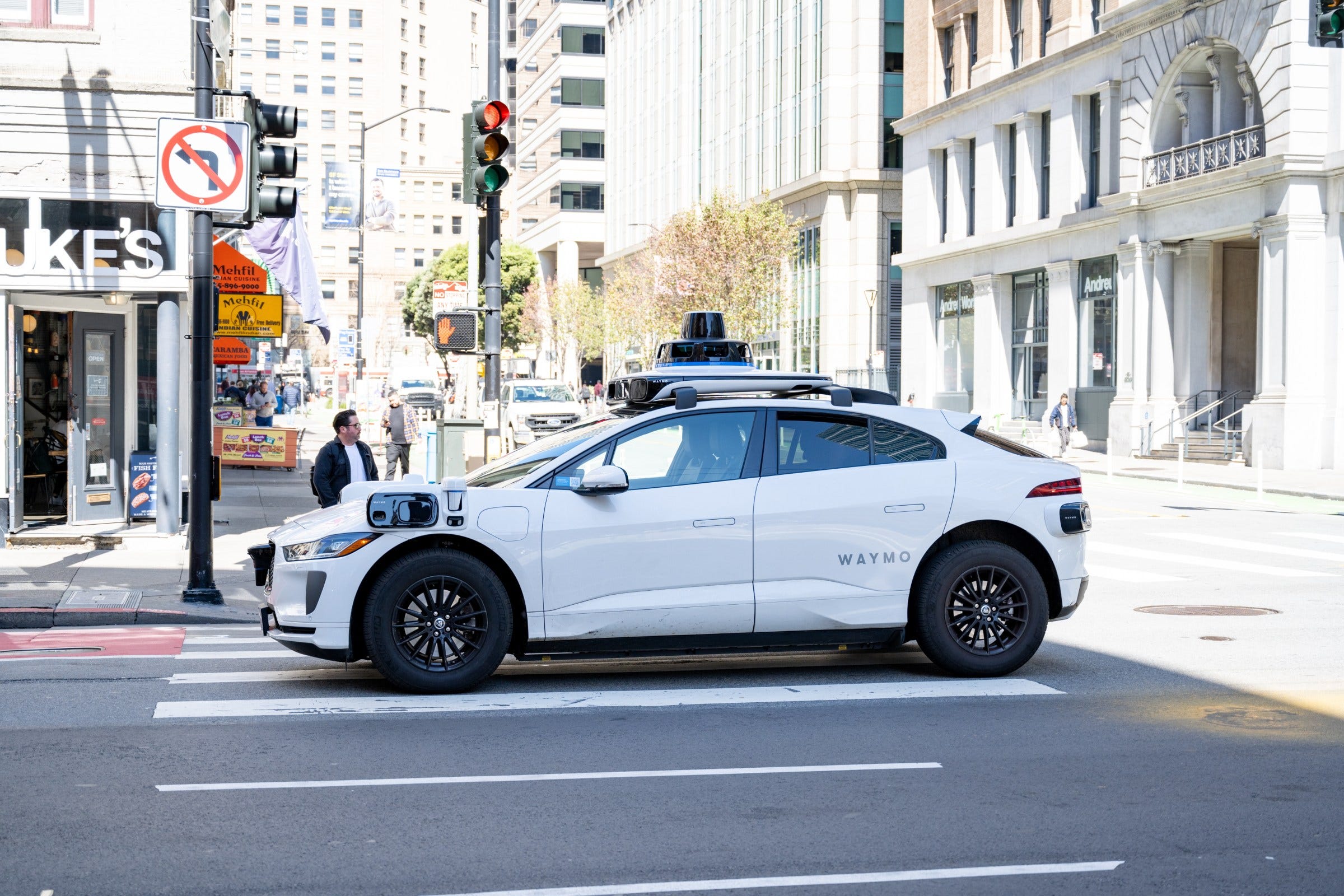
Gado via Getty Images
Human drivers are constantly distracted by phones, discussions, podcasts, and music. We are either angry, sleepy, impaired, or all three. Worst of all, even when we’re firing on all cylinders, our brains are often no match for the speed and complexity of high-speed driving. There’s a 2 to 3 second lag between what we perceive, and how fast we can react, in a vehicle traveling 60+ mph, which means a car will travel the equivalent of two basketball court lengths (188 feet), before its driver can even hit the brake.
Good News
The result of this very human fallibility is blood on the streets. Nearly 1.2 million people perish in crashes “on the road globally each year”, enough to fill nine jumbo jets “each day”. The US government believes there were nearly 40,000 driving fatalities last year, which adds up to a bus’s worth of people perishing every 12 hours. We feel deeply sad for any of you, that grieve for a loved one that passed away in a car accident.
Related
The good news is, there are much, much better drivers coming online, and they have everything human drivers don’t: They don’t need sleep. They don’t get angry. They don’t get drunk. And their brains can handle high-speed decision-making with ease.
Because they’re AI.
AI takes the wheel
One of the true benefits of a self-driving revolution will be in lives saved. And new data from the autonomous vehicle company Waymo suggests that those human savings could be very great indeed. Think of how productivity and relationships can be positively impacted, if we work or network while our cars drive without our need to pay attention “at all”.
Related
Waymo, which spun out of Google’s ambitious self-driving car project in 2009, is viewed as one of the global leaders in autonomous taxi driving technology. They just announced on 5/21/25 that they have surpassed $10,000,000 million paid rides!
Waymo analyzed the safety performance of its autonomous vehicles over the course of 56.7 million miles driven in Austin, Los Angeles, Phoenix, and San Francisco — all without a human safety driver present to take the wheel in an emergency. They then compared that data to human driving safety over the same number of miles driven on the same kind of roads.
The results of the study, the biggest and most comprehensive research on self-driving car safety yet released, are striking.
A master class in driving safety
Compared to human drivers, the Waymo self-driving taxi cars had:
-
81 percent fewer airbag-deploying crashes
-
85 percent fewer crashes with suspected serious or worse injuries
-
96 percent fewer injury crashes at intersections (primarily because Waymo detects other cars running red lights faster than humans)
-
92 percent fewer crashes that involve injuries to pedestrians.
Back-of-the-envelope calculations suggest that if the same 85 percent reduction seen in serious crashes held true for fatal ones — a big if, since the study had too few fatal events to measure — we’d save approximately 34,000 lives a year. Also keep in mind that robotaxis are still limited to only street driving, no highways or freeways as yet. Therefore, it gives the numbers a chance to be skewed in the Waymo favor, for now.
Don’t get in the way of progress
The above info is also a Waymo company-run study, though it has been peer-reviewed by outside experts. There are caveats to the Waymo study, so we take that with our grain of salt. We also heard of the recent recall of 1,200 Waymo vehicles, for software updates, due to the cars sometimes being unable to identify roadway orange cones, parking lot chains and barriers.
Serious injury crashes are (thankfully) very rare, even 56.7 million miles isn’t long enough for researchers to be really sure that such crashes would occur significantly less often with robot drivers. We realize more data will be needed there. Waymo’s cars were also being driven largely in warm, sunny locations, operating in geofenced areas that had been heavily mapped by the company. It’s far less certain how they might do in, let’s say, the snowy streets of Boston in the winter.
Still, the data looks very good, and with the current death toll on our roads, I’d argue slowing down the time frame for autonomous vehicles is costing lives.
Insight:
Toyota Motor Corp. and Waymo will collaborate on the development of an autonomous vehicle platform, the automaker announced this past April.
Waymo currently provides 250,000 paid trips “each week” in the San Francisco Bay Area, Los Angeles, Phoenix, and Austin, and soon plans to launch its ride-hailing service in Washington, D.C. and Miami.
Through December 2024, Waymo’s autonomous ride-hailing fleet has completed 50 million miles of rider trips (total of paid and unpaid) without a human safety driver onboard. The company also surpassed over 20 billion miles of testing in computer simulation. Waymo continuously collects data from its fleet that’s used to refine and improve the safety of its AV technology.
In October 2024, Waymo closed on an investment round of $5.6 billion dollar, led by parent company Alphabet, which will help fund the continual expansion of its Waymo One ride-hailing service.
The Waymo Driver is designed to be compatible with a variety of vehicle platforms. Its advanced hardware suite includes 13 cameras, four lidars, six radar units and an array of external audio receivers installed on vehicles. When combined with high-resolution maps for navigation, it allows vehicles to operate autonomously with a high level of safety.
Waymo is also collaborating with other automakers including Stellantis, Mercedes-Benz Group AG, Jaguar Land Rover, Volvo Cars. Last October, Hyundai Motor Co. entered into a multiyear partnership with Waymo, to equip its electric Ioniq 5 with autonomous driving technology and add the EVs to the Waymo One ride-hailing service. Uber announced a multi-year strategic partnership with Waymo in May 2023, to deploy AVs on the Uber platform. These strategic alliances are crucial for Waymo’s efforts to develop, integrate, and deploy its autonomous driving technology.
I watched an interview this week on You Tube (an Alphabet Company) featuring Sundar Pichai the CEO of Alphabet, owners of Waymo. It was mentioned by the interviewer – that just the Waymo piece of Alphabet (Google) alone will be a $100 billion dollar a year business in the near future.
Now Tesla is destined to be a true winner in the Humanoid Robotic brand sector coming soon. They also have serious success in future with Colossus (Quantum), xAI, Space X and X (formerly Twitter). Of course, they also have the Boring company and Neuralink as well. Elon’s future is bright no one can argue. One thing that Musk does different is he often starts a company with no intention of it ever being under the Tesla family of companies, so your Tesla stock shares do not benefit from all his other company’s success.
Elon announced today, they will have “ten Tesla’s in a geofence pen next month in Austin Tx”. These ten cars will have no drivers, but humans will have remote controls for those ten cars, outside the vehicle, “if needed”. If that is their starting point, it seems like they are a bit behind in this race, but I would not put it past Elon to catch up, at some point. Tesla uses only camera sensors in Tesla autonomous driven cars. No lidar and radar, plus cameras like Waymo, so this could be an advantage, we will see.
Too often the public focuses on the unusual events of self-driving cars because of it still being considered “new tech”: we are referring to the accidents, that happen with self-driving cars. Meanwhile, the accident carnage that occurs, thanks to human drivers, on a daily basis, is simply treated as background noise.
It will be interesting to see how this “auto car plays out”, between Tesla and Waymo, for a TAM (total annual market) worth at least a half a trillion dollars. The reason I tend to back Waymo and Alphabet? One is their professionalism; their engineering department is legendary. They have accuracy and transparency in the quarterly / annual guidance they give, and it’s impressive what they have done with the other companies that they own under the Alphabet umbrella, like You Tube, DeepMind (Quantum), Google Search now becoming Gemini AI, and Android (still the largest mobile player in the world).
So, get in, sit down, buckle up, grab a drink …er soda, and put on some music you prefer, let someone else take the wheel going forward. Stay tuned, this should get good.
Any content marked as Stock Talk may be paid for and are not endorsed or warranted by our staff or company. The content in our posts and notes is for educational or entertainment use and is not a substitute for professional advice or an offer to buy or sell any securities. Neither the publisher nor the editors are registered advisors, and we do not provide personalized counseling, only the teachings of what has worked for us and others. We can show you the means to do your own careful research, before you take your own action, based on anything you find in this content. By opening this email or clicking any links contained, you are reconfirming your opt-in status.